If I had to describe 2025 in one sentence, it would be this:
2025 was the year content shifted from AI-generated to AI-assisted.
Not because AI suddenly became better overnight, but because creators became more realistic about what actually works. The novelty faded. The shortcuts stopped delivering. And what replaced them was something slower, quieter, and far more effective: systems, judgment, and intent.
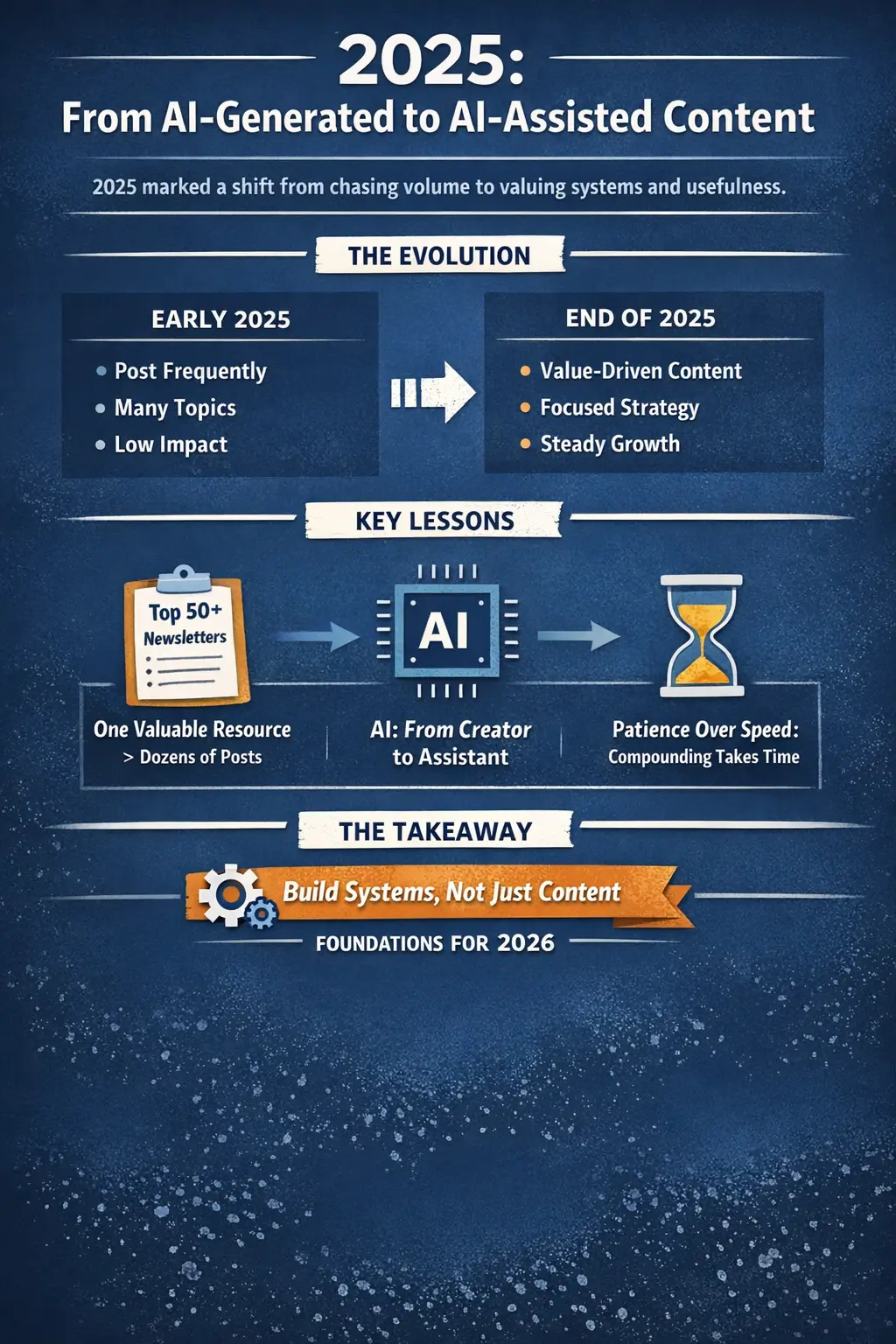
For me, 2025 wasn’t a year of explosive growth or viral moments. It was a year of recalibration. Of unlearning some habits, doubling down on others, and finally seeing how content can compound when it’s built properly.
How 2025 Started (and What I Thought Would Work)
At the start of the year, my thinking wasn’t unusual.
Publish regularly. Cover a wide range of topics. Put enough content out and something will stick. That approach had worked in the past, so it felt reasonable to keep pushing volume.
I was writing across lots of different ideas, trying to be helpful in many directions at once. In isolation, the content wasn’t bad. But collectively, it lacked gravity. Things didn’t rank the same way they used to. Traffic didn’t compound. The effort felt high relative to the results.
Looking back, the problem wasn’t effort. It was dilution.
When “More Content” Quietly Stopped Working
One of the clearest lessons from 2025 was realising that more content no longer meant better outcomes.
Search results felt more competitive. Audiences felt more selective. Publishing twenty reasonable blog posts didn’t outperform publishing one genuinely useful resource.
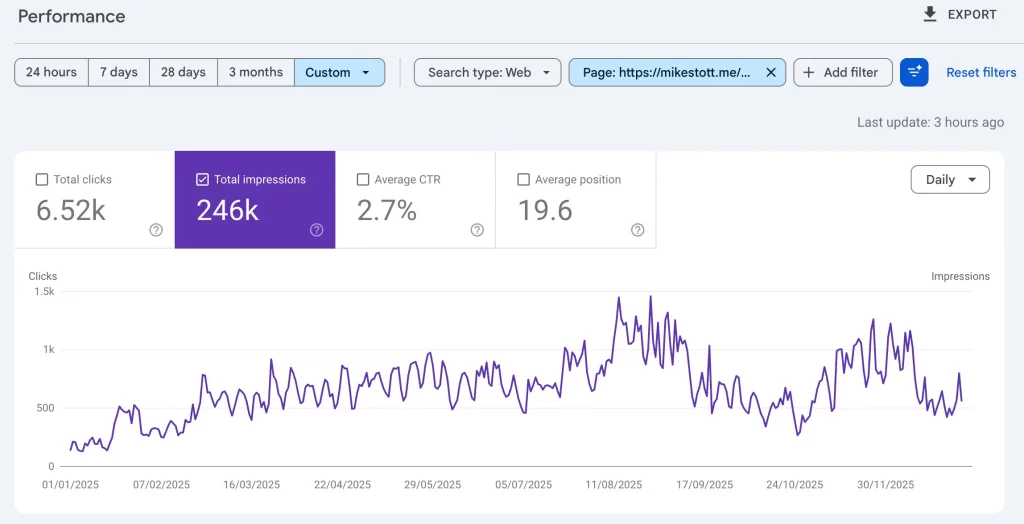
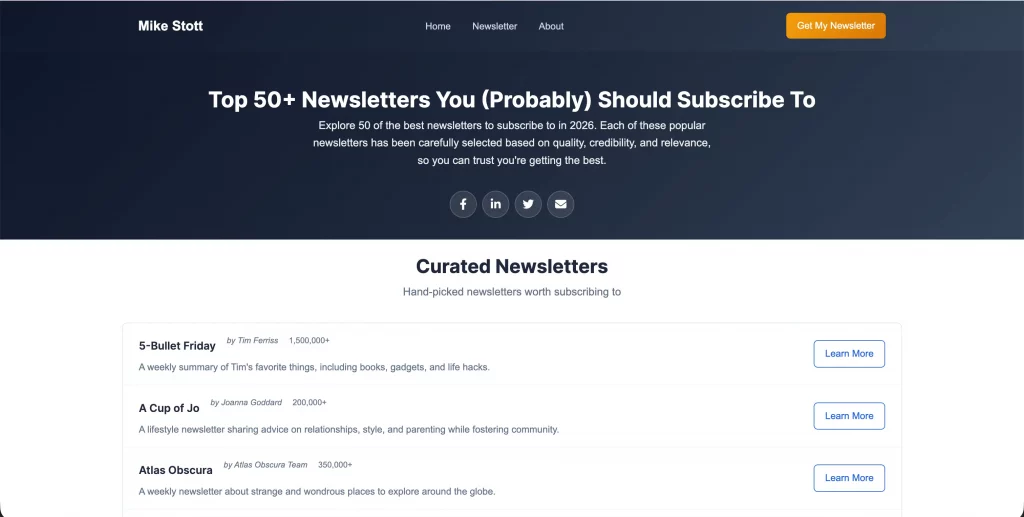
The turning point came with a single piece of content: my page the 50 best newsletters to subscribe to started to pick up traffic.
That piece of content did something the others didn’t. It solved a real problem clearly. It was easy to understand why it existed. And it delivered value without asking for anything in return.
It started ranking. Slowly at first. Then more consistently. Traffic followed. Subscribers followed.
That one piece of content outperformed dozens of earlier attempts. Not because it was clever, but because it was useful.
Value Changed Direction, Not Just Results
That success forced a rethink.
It became obvious that this site and this newsletter couldn’t be about lots of loosely connected topics. It needed a spine. A point of view.
That’s where the idea of Your Content Isn’t Converting Because You Don’t Have a System properly took shape. Not conversion in the pushy sense, but conversion as a system: helping people go from not knowing what to write, to ranking content, to turning readers into subscribers, clients, and eventually advocates.
From there, the thinking evolved into the five-phase system you see today and what I write about in My Newsletter. Suddenly, content ideas weren’t random anymore. They had a place. A role. A purpose.
That clarity didn’t just help the audience. It made creating content easier, calmer, and more intentional.
AI: From Experiment to Infrastructure
AI followed a similar arc.
At the beginning of 2025, AI for me mostly meant ChatGPT. It was impressive, occasionally useful, and easy to overuse.
As the year went on, AI became less of a destination and more of a layer inside the workflow. I started using it end-to-end: keyword research, outlining, drafting, rewriting, editing, and refining.
Sometimes content started as dictated thoughts. Sometimes as messy notes. AI helped shape and clarify, but it didn’t originate the thinking.
The biggest shift was this: AI stopped being the thing that created content, and became the thing that supported thinking.
Interestingly, one area where I use AI less now is image generation. It still struggles with nuance, accuracy, and consistency. In many cases, it’s quicker to do that work manually.
That reinforced a broader rule that held true all year: tools don’t replace taste. They amplify it – or expose its absence.
The Biggest Mistake I Saw Creators Make
If there’s one mistake I saw repeatedly in 2025, it’s this:
People gave up too early.
I saw creators launch sites and expect traction in weeks. Publish for a month or two, see little movement, and decide it “doesn’t work.” The assumption was always speed.
This site took a long time. Impressions took time. Traffic grew slowly. Progress came through iteration, not momentum. Posts were rewritten. Ideas refined. Focus narrowed.
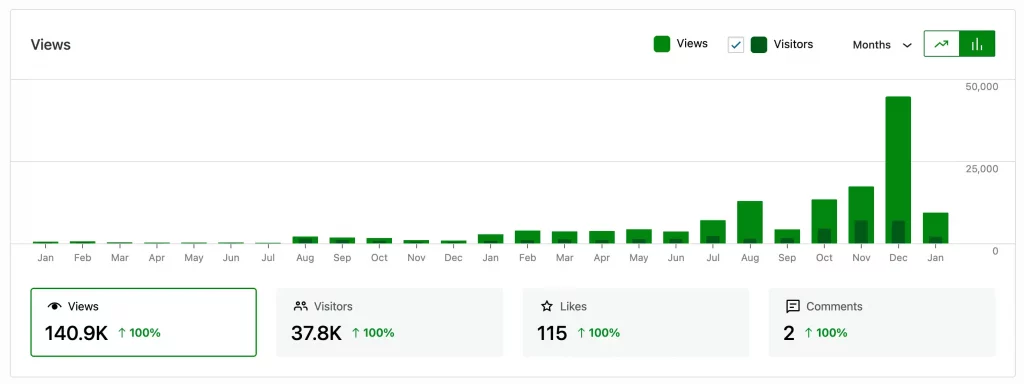
2025 reinforced an uncomfortable truth: content rewards patience, and most people quit just before compounding begins.
Friction, Consistency, and Slowing Down on Purpose
Personally, my biggest friction this year was consistency – or more accurately, forced consistency.
The newsletter originally went out weekly. On paper, that sounded disciplined. In reality, it encouraged rushing. Ideas didn’t get the depth they deserved. The quality suffered.
Eventually, I stopped. I reduced it to once a month.
Instead of reacting to the week, each issue now covers the bigger themes in content creation. Alongside that, I spent a significant amount of upfront time rewriting the entire five-phase content system and email sequence from scratch.
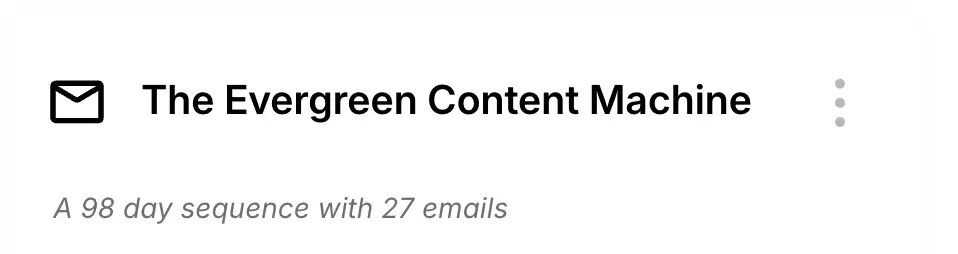
That work wasn’t immediately visible. But it raised the floor for everything that followed.
The lesson was simple: fewer outputs, better thinking, more leverage.
What Surprised Me in 2025
One thing I didn’t expect to matter — or rather, not matter — was whether content was AI-assisted.
By the end of the year, people largely stopped caring. What readers responded to were ideas, clarity, and usefulness. AI had become part of the background.
Except for em dashes, yes those above were intentional by me 🙂
It became clear that garbage in, garbage out still applies. Whether you’re writing every word yourself or working with AI, the thinking still determines the outcome.
That acceptance shifted the focus back to where it belongs: the quality of ideas.
A Calmer Way of Thinking About Content
By December, my relationship with content felt calmer than it had in years.
Clearer that this is a marathon, not a sprint. Clearer that learning matters as much as publishing. Clearer that algorithms change, formats evolve, and what worked in January may not work in December.
The creators who progress aren’t the ones who cling to a single tactic. They’re the ones who keep learning, testing, and adapting – whether that’s SEO, newsletters, short-form video, or new AI-assisted workflows.
Who This Is For
This recap – and this site – is for people who want content to do something.
If you have a website and you’re selling a digital product, offering a service, coaching, or running a small business, content can help you stand out. But only if it’s intentional. Only if it leads somewhere. Only if it turns attention into trust, and trust into action.
That’s what 2025 clarified for me.
What 2025 Set Up for 2026
2025 wasn’t about hacks or speed.
It was about foundations.
Going into 2026, the advantage belongs to creators who build systems, not streaks. Who create fewer things that work longer. Who treat content as an asset rather than a task.
That’s the direction I’m heading in. And if you’re still here reading this, you probably are too.
Leave a Reply